Recliner Buying Guide: Clearance, Controls and Access
Check a recliner in every position, including wall clearance, footrest space and controls. Compare manual and powered models by verified details.
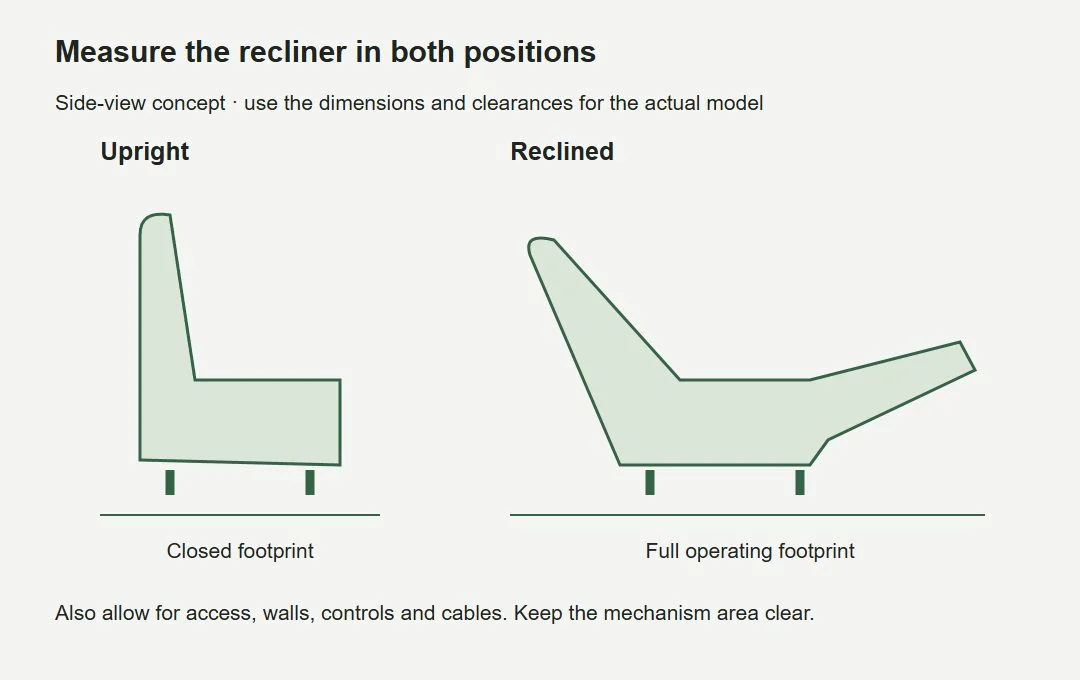
A recliner needs room to move, not just room to stand. The dimensions of the closed chair are only the beginning: the back, footrest and sometimes the seat travel as the mechanism operates.
Before choosing one, find the full reclined dimensions and the manufacturer’s required clearances. If those details are missing, ask for them. Do not assume that a chair described as compact can operate close to every wall.
Measure three areas
The closed footprint: overall width and depth, including arms and any controls that project from the side.
The operating footprint: space behind the back and in front of the footrest throughout the movement, using the instructions for that model.
Your access: room to approach, sit down, use the controls and leave the chair comfortably.
Mark those areas on the floor together. Include a nearby table, other seating and the normal route through the room. A footrest that opens into the main walkway can make an otherwise suitable corner inconvenient.
Choose controls you can reach and use
Check whether the chair uses a manual release, body pressure, buttons or a remote. Read how the footrest returns and whether the action suits the intended user. A power recliner is not automatically a lift chair, and a recliner should not be assumed to provide a medical benefit.
If it needs electricity, locate a suitable outlet and plan the cable route according to the supplied instructions. Keep cables away from the moving mechanism and walking paths. Do not choose the position first and leave the power arrangement as an afterthought.
Check any stated user or load limits and the required assembly. If a control, support feature or function is important, confirm that it belongs to the selected model rather than another chair in the same range.
Moving parts need clear space
Keep children and pets away from the mechanism and check the area before operating it. NSW Government guidance on recliner-chair safety identifies entrapment risks and advises against children playing around the mechanism. Follow the manufacturer’s warnings for the chair.
Compare the seat while it is upright too
You may spend plenty of time sitting without reclining. Compare seat height, depth, back shape and arm position, using a chair you already know as a reference. Specifications help narrow the choice, but do not establish an individual comfort rating.
The armchair footprint guide helps with those static measurements. Keep the extra operating space on the plan as a separate requirement rather than treating it as spare space you can fill with a table.
Check the route into the room
Ask for the packaged dimensions and whether any assembly or removal of parts is permitted. Do not assume that the back detaches because another recliner’s back does. Measure access for bulky furniture, including turns, lifts and stairs where relevant.
Before ordering, your notes should identify the exact model, closed and open dimensions, required wall clearance, control type, power needs and delivery route. When those are settled, you can choose the finish with a much clearer idea of how the chair will work at home.